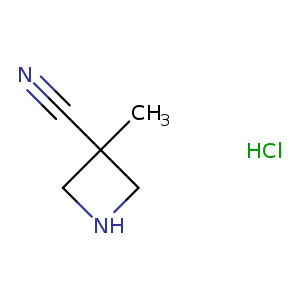
| Chemical Name: | 3-Cyano-3-methylazetidine hydrochloride |
| CAS Number: | 936850-33-8 |
| Product Number: | AG00H0XH(AGN-PC-0WA8JL) |
| Synonyms: | |
| MDL No: | |
| Molecular Formula: | C5H9ClN2 |
| Molecular Weight: | 132.5914 |



3-Methylazetidine-3-carbonitrile hydrochloride, also known as 3-MAC and chemically represented as C5H9N2Cl, is a versatile compound widely used in chemical synthesis. This unique molecule plays a crucial role as a building block in the development of various pharmaceuticals, agrochemicals, and materials.One key application of 3-Methylazetidine-3-carbonitrile hydrochloride lies in its utility as a key intermediate in the synthesis of bioactive compounds. It is commonly employed in the preparation of heterocyclic structures, which are essential components in the design of diverse pharmaceutical agents. The incorporation of 3-MAC into these molecular frameworks enables the creation of new compounds with enhanced biological activities and improved properties, making it a valuable tool in drug discovery and development.Furthermore, 3-Methylazetidine-3-carbonitrile hydrochloride serves as a valuable precursor for the synthesis of various functionalized molecules. By leveraging its unique chemical reactivity, researchers can introduce specific functional groups or moieties onto the 3-MAC scaffold, enabling the creation of structurally diverse compounds with tailored properties. This flexibility opens up opportunities for the exploration of new chemical space and the development of innovative materials with a wide range of applications.In summary, the application of 3-Methylazetidine-3-carbonitrile hydrochloride in chemical synthesis offers a pathway to access novel compounds with diverse functionalities and applications. Its role as a versatile building block underscores its importance in advancing the field of organic chemistry and driving innovation in drug discovery, materials science, and agrochemical research.




![O=C(C=Cc1ccccc1)C=Cc1ccccc1.O=C(C=Cc1ccccc1)C=Cc1ccccc1.O=C(C=Cc1ccccc1)C=Cc1ccccc1.[Pd].[Pd]](https://img.angenechemical.com/storage/3a59/3a5932eec850ab245f6f4d4a7f9497f9.png)
(Cl)Cl)c1c(C)cc(cc1C)C](https://img.angenechemical.com/storage/6693/66939a3f08a27d2b6717c3194e00970b.png)