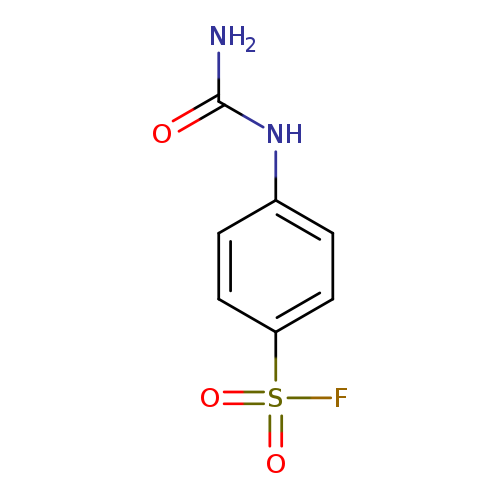
| Chemical Name: | 4-(carbamoylamino)benzene-1-sulfonyl fluoride |
| CAS Number: | 1193387-13-1 |
| Product Number: | AG019W2H(AG019W2H) |
| Synonyms: | |
| MDL No: | |
| Molecular Formula: | C7H7FN2O3S |
| Molecular Weight: | 218.2055 |


4-(Carbamoylamino)benzene-1-sulfonyl fluoride, also known as CBSF, is a versatile compound that finds extensive application in organic synthesis. This compound serves as a key intermediate in the preparation of various pharmaceuticals, agrochemicals, and advanced materials. In organic synthesis, CBSF is commonly employed as a reagent for the introduction of the sulfonyl fluoride functional group into a variety of organic molecules. This transformation is particularly valuable in medicinal chemistry, as the sulfonyl fluoride moiety can enhance the biological activity and metabolic stability of the resulting compounds. Specifically, CBSF is utilized in the synthesis of sulfonyl-containing compounds such as sulfonamides, sulfonylureas, and sulfonate esters, which exhibit diverse pharmacological properties. Furthermore, the presence of the carbamoylamino group in CBSF imparts additional versatility, allowing for the selective modification of specific functional groups in target molecules.Overall, the strategic use of 4-(Carbamoylamino)benzene-1-sulfonyl fluoride in chemical synthesis enables rapid and efficient access to structurally complex compounds with potential applications in drug discovery and material science.




![O=C(C=Cc1ccccc1)C=Cc1ccccc1.O=C(C=Cc1ccccc1)C=Cc1ccccc1.O=C(C=Cc1ccccc1)C=Cc1ccccc1.[Pd].[Pd]](https://img.angenechemical.com/storage/3a59/3a5932eec850ab245f6f4d4a7f9497f9.png)
(Cl)Cl)c1c(C)cc(cc1C)C](https://img.angenechemical.com/storage/6693/66939a3f08a27d2b6717c3194e00970b.png)